Author: admin

  • PENB Label Approximation – Part 4: Turning the Calculation into an App for Everyday Users

    Part 4: Turning a Calculation into an App for Everyday Users

    Why the Right Model Isn’t Enough

    Many technical projects fail not because the model is wrong, but because real users can’t interact with it. For a PENB approximation app, this is especially important since the target audience isn’t just analysts.

    A usable public app must meet three requirements at once:

    • the user must understand what to enter,
    • the system must receive consistent input,
    • the output must be readable even without deep technical knowledge.

    Five Steps Instead of One Overwhelming Screen

    The current interface uses a logical breakdown into several steps: location, apartment, data, calculation, and result. This is important for practical reasons.

    When people see everything at once, it’s easy to lose context. Guiding them step by step increases the chance of correct input.

    This isn’t just a UX rule. It’s also a way to improve the quality of data that ultimately reaches the model.


    The Form as Part of Domain Logic

    A public app shouldn’t just be a thin layer over the backend. In this project, the form actively helps structure the input:

    • guides users to the truly essential information,
    • distinguishes between quick and detailed calculation modes,
    • handles months without heating and hot water right at input,
    • sets the stage for interpreting the result.

    From this perspective, UX is not separate from data science. It’s one of the layers that determines whether the model receives meaningful input.


    The result must be understandable, not just accurate

    The user usually doesn’t need to know all the internal calibration parameters. They need to understand:

    • what energy class the calculation yields,
    • how reliable the estimate is,
    • what the interpretation limits are,
    • what the next logical step is.

    That’s why the output combines the energy class, key metrics, a written comment, and an exportable report. The result serves as a communication artifact, not just a technical intermediate output.


    Bilingualism as a product feature

    An interesting part of the project is that the application isn’t just prepared for local testing. It has both Czech and English language versions. This increases usability for project presentations, sharing with clients, and further development.

    Technically, this means more work. But from a product perspective, it significantly boosts the application’s overall value.


    What’s next

    In the final part, I’ll cover deployment, report export, current project limitations, and what I would expand or refine in the next iteration.

  • PENB Label Approximation – Part 3: Weather, Heating Season, and RC Model Without Magic

    Part 3: Weather, Heating Season, and the RC Model Without Magic

    Why Consumption Alone Isn’t Enough

    The same energy use can mean something different in January than it does in April. Without the context of weather and season, it’s impossible to reasonably estimate how much energy is actually explained by heating.

    That’s why the app isn’t just about uploading a CSV. Alongside operational data, it also adds meteorological context for the specific location.


    Hybrid Weather Layer as a Practical Choice

    In an ideal world, there would be a single perfect data source, always available and never down. In reality, it’s better to assume that the network, API, or historical data coverage won’t always be perfect.

    That’s why the project uses a multi-layered approach:

    • recent data comes from WeatherAPI,
    • older history is filled in via Open-Meteo,
    • and only as a last fallback does it use a synthetic approximation.

    This isn’t just a technical detail. It’s an example of how robustness is built into the data layer from the start.


    Where the Heating Season Comes In

    Energy consumption isn’t homogeneous. Some months are mainly about heating, others reflect regular operation and hot water. If the model doesn’t distinguish this, it starts calibrating the wrong signal.

    That’s why the user selects non-heating months in the app, and the system uses them when estimating consumption components. It’s not an unnecessary detail—it’s one of the most important steps in the entire logic.


    Why the RC Model

    A simplified RC model isn’t interesting because it’s theoretically the most complex. It’s valuable because it offers a reasonable balance between:

    • domain interpretability,
    • computational simplicity,
    • the ability to calibrate with real data.

    The model helps translate apartment behavior into a structure you can actually work with. It’s not a “black box,” but an explainable approximation of thermal dynamics.


    Multiple Calculation Modes Matter

    The app now offers several calculation modes. This matters not just for performance, but also for the nature of available data.

    • sometimes a quick estimate is enough,
    • other times local optimization makes sense,
    • and for more demanding cases, robust calibration is possible.

    This is a good example of a product compromise: instead of forcing everyone into one “right” mode, offer several paths based on input quality and user expectations.


    What’s Next

    In the next part, I’ll move from the calculation core to the user layer: why having the right model isn’t enough, how the interface steps were designed, and why UX is part of technical quality for tools like this.

  • PENB Label Approximation – Part 2: Turning Regular Consumption Data into Valid Input

    Part 2: Turning Regular Consumption Data into Valid Input

    A model is only as good as its input

    In projects working with operational data, the biggest mistake is often assuming the main value lies in the algorithm itself. In reality, the quality of the outcome is often determined before any calculation happens.

    For PENB approximation, it’s especially critical that the application correctly understands:

    • what consumption data is available,
    • which period it covers,
    • when the user is heating and when not,
    • which part of the energy likely relates to heating and which to hot water or regular use.

    What the application actually needs from the user

    The practical input is intentionally kept fairly simple:

    • location,
    • apartment area and ceiling height,
    • type of heating,
    • temperature regime,
    • consumption time series,
    • selection of non-heating months,
    • method for hot water approximation.

    This is an important compromise. If the application asked for too many details, most users wouldn’t finish. If it asked for too little, the result would lose its grounding in reality.


    Why uploading a CSV isn’t enough

    Uploading a file is technically easy, but not enough in terms of data. Consumption alone doesn’t tell you:

    • whether it’s heating or another component,
    • whether there are gaps in the data,
    • whether the observations match the heating season,
    • whether the measurement period is sufficient for the chosen calculation mode.

    That’s why the workflow includes selecting non-heating months and splitting energy into heating-related and hot water or regular usage parts.


    Validation isn’t about restricting the user

    Good validation doesn’t feel like a barrier. It’s a way to prevent the app from returning a confident result based on inconsistent data.

    In this project, validation handles for example:

    • minimum data length based on calculation mode,
    • input field logic for heating type,
    • consistency of temperature regime,
    • presence of expected columns in the input file.

    From a product perspective, this matters because users get feedback early—not after several minutes of calculation.


    Why this is interesting for data science

    A workflow like this shows that data science in production isn’t just about modeling. It’s also about designing how data enters the system so results are repeatable and interpretable.

    This is exactly where:

    • data quality,
    • domain logic,
    • form UX,
    • and the operational reality of everyday users meet.

    What’s next

    In the next part, I’ll look at the core of the estimation: how weather data enters the app, why it’s important to distinguish the heating season, and the role of a simplified RC model in calibrating the apartment’s energy behavior.

  • PENB Label Approximation – Part 1: Why Waiting for a Formal Audit Isn’t Enough

    Series: PENB Energy Label Approximation – Lessons from Building a Public Application

    Series goal:
    Describe the project from problem definition through data and modeling to public deployment, highlighting where data science, product thinking, and quality implementation meet.


    Related Parts

    1. Why waiting for a formal audit isn’t enough – when an indicative calculation is more useful than waiting.
    2. How to turn regular consumption into valid input – what needs to be prepared before the model can start.
    3. Weather, heating season, and an RC model without magic – where domain logic meets data.
    4. How to turn a calculation into an app for everyday users – why UX is more than just cosmetics.
    5. Deployment, limitations, and what’s next – what works today and what should come in the next iteration.

    Part 1: Why waiting for a formal audit isn’t enough

    Where the real problem started

    A formal PENB makes sense when you need to meet a legal requirement or need a final document for sale or rental. But most decisions happen earlier.

    People want to know:

    • if their consumption is normal,
    • whether it’s worth investing in apartment improvements,
    • if a specific apartment is suspiciously energy-intensive,
    • whether it makes sense to proceed with deeper analysis.

    At this stage, a formal audit is usually too slow. You need a quick but still defensible signal.


    The hardest part isn’t the calculation, but defining the problem correctly

    Projects like this clearly show the difference between a technically interesting model and a practically useful product.

    The technical question is:

    Can you estimate an apartment’s energy consumption from operational data?

    The product question is different:

    Can you quickly and clearly help someone decide whether it’s worth analyzing their apartment in detail?

    The second question is more important. That’s why this app wasn’t created as a replacement for a certified PENB, but as a tool for initial orientation.


    Why operational data makes sense

    People often don’t have the building’s technical documentation at hand, but they do have:

    • bills and consumption data,
    • basic apartment parameters,
    • information about the heating source,
    • a rough idea of how they use the apartment.

    It’s not a perfect dataset. But it’s a dataset that actually exists. And a good product often starts where data is truly available, not where it would be ideal.


    What such a tool must deliver

    For the app to be useful, it must meet four criteria:

    • be fast, so it helps even before a formal audit,
    • be clear, so the result isn’t just another technical barrier,
    • openly acknowledge limitations, because uncertainty can’t be hidden,
    • be publicly accessible, so the principle can be demonstrated immediately in practice.

    That’s also why the project didn’t end up as just a notebook script. From the start, it was headed toward becoming an application.


    The value for users is in decisions, not just numbers

    The energy class itself is only part of the result.

    The greater value is that the application helps answer practical questions:

    • is it worth continuing with due diligence,
    • is the consumption consistent with the apartment’s parameters,
    • is it appropriate to plan a renovation,
    • is it worth ordering a detailed audit.

    In other words: the project stands out because it turns unclear operational data into an actionable framework for the next step.


    What’s next

    In the next part, I’ll look at why it’s critical for this kind of application to properly prepare input data, how to separate heating from regular usage, and why input validation often matters more than model optimization itself.

  • PENB Label Approximation – Part 5: Deployment, Limitations, and What’s Next

    Part 5: Deployment, limitations, and what’s next

    When does a project become a real project

    As long as the calculation only runs locally, it’s just an experiment. The moment you can open it at a public URL, switch languages, go through the workflow, and download a report, it starts to become a real product.

    That’s the case with this app. The computational logic matters, but it’s just as important that it’s deployed as a publicly accessible service.


    What brings operational value

    Today, the project stands on several practical building blocks:

    • containerized deployment in Docker,
    • separate Czech and English versions,
    • persistent storage for local state and reports,
    • HTML export of results,
    • clear separation of UI, model, and reporting layer.

    These are exactly the elements that determine whether the app can be further developed without rewriting it from scratch.


    Transparency about limitations is part of quality

    For a tool like this, it’s important not only what it can do, but also what it can’t do yet or only handles approximately.

    With the current implementation, it’s good to be open about, for example:

    • the output is indicative, not a certified PENB,
    • the reference year in the MVP is an approximated typical year, not a full TMY dataset,
    • result quality depends on the scope and consistency of input data,
    • some parts of the result presentation still have room for further development.

    This is not a weakness in communication. It’s its professionalization.


    What I would develop in the next iteration

    If the project were to continue to the next version, I believe these directions would make the most sense:

    • more precise handling of the reference year and climate scenarios,
    • expanding the interpretation of results with further recommendations,
    • deeper work with visualizations and calibration explanations,
    • more robust handling of a wider range of input situations.

    These steps would not only advance the technical side of the model. They would also increase user trust in the output and the ability to use the tool in real decision-making.


    Key takeaways from the whole series

    The PENB approximation project clearly shows that a quality data application doesn’t arise from a single clever idea. It emerges from the interplay of several disciplines:

    • choosing the right problem,
    • a reasonable model,
    • a quality data workflow,
    • a usable interface,
    • and deployment that allows the result to be truly used.

    This combination, in my view, is more interesting than the mere fact that the application returns an energy class.

  • EPC from operational data: where estimation ends and decision begins

    EPC from operational data: where estimation ends and decision begins

    The EPC Energy Label Approximation project shows that even without a lengthy manual process, it is possible to obtain a useful first estimate of a flat’s energy performance from operational data. The aim is not to replace the official energy performance certificate, but to offer a fast, understandable and data-driven view of how the property is likely to perform.


    How the application looks in practice

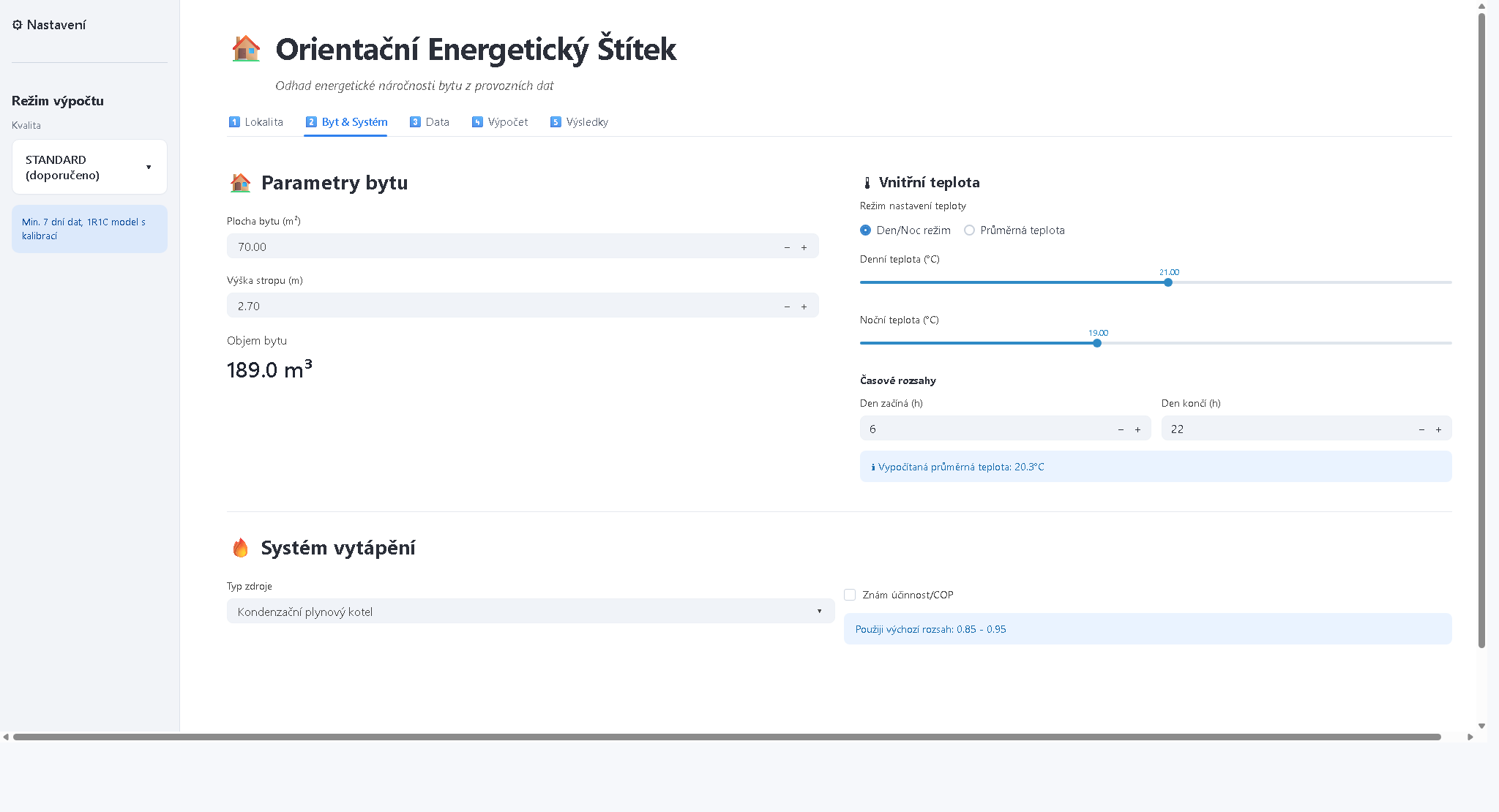
    The first demo shows part of the workflow where the user enters the basic parameters of the apartment, the indoor temperature regime and the type of heating. This is where it becomes clear how important it is to combine technical correctness with simple operation, so that the input to the model is understandable even for the average user.


    Screenshot of the PENB application interface for apartment parameters, indoor temperature and heating system
    Example of the input form for apartment parameters, temperature profile and heating system.

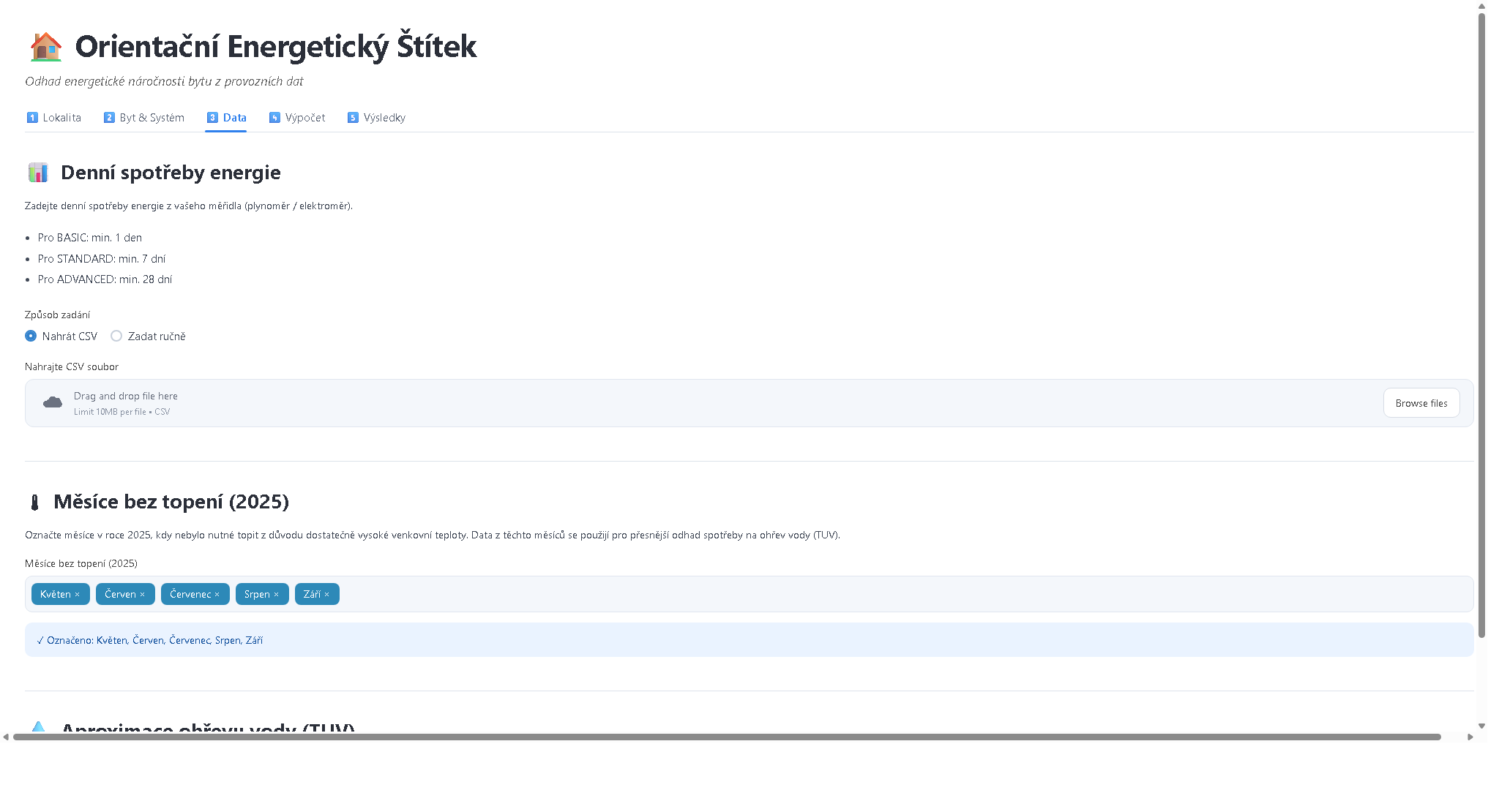
    The second demo focuses on the data layer: uploading a CSV with consumption data, selecting non-heating months and approximating water heating. This is an important point where simple operational data starts to become the basis for a qualified estimate.


    Screenshot of the PENB application interface for uploading consumption data, selecting non-heating months and DHW approximation
    Example of the data part of the application: consumption, non-heating months and DHW model approximation.


    What the project solves

    In practice, the same problem often arises: you have energy consumption, the basic parameters of your apartment and you want to get your bearings quickly.

    • Is the consumption reasonable or is it already suspiciously high?
    • Does it make sense to invest in insulation, window replacement or a change of heating source?
    • How to distinguish an expensive renovation with little impact from an intervention that really helps?

    This is where an indicative calculation makes sense. Instead of waiting for the whole formal process, the user can get the first data signal for further decision making in a short while.


    Added value for the user

    For the owner or tenant of an apartment

    • faster orientation as to whether the consumption corresponds to the size and type of the apartment,
    • a better basis for decisions on savings and renovation,
    • a more comprehensible explanation of why the energy bill looks the way it does.

    For the buyer or investor

    • a quick screening of the property before deeper due diligence,
    • a better estimate of future running costs,
    • an additional argument when negotiating the price or the scope of the investment.

    For a consultant, developer or portfolio manager

    • the ability to prioritise which flats or units to deal with first,
    • clearer communication with the customer,
    • the basis for productising a service that combines a technical estimate with a business recommendation.

    Business value in one sentence

    The main benefit of the project is that it turns unclear operational data into a quickly usable basis for decision-making. This is a value in itself: less guesswork, fewer blind investments and a faster path from question to action.


    How it works for laymen

    Simply put, the application does five things:

    1. It takes basic information about the apartment, heating and energy consumption.
    2. It supplements it with meteorological data for the given locality.
    3. It estimates what part of the consumption is related to heating and what to normal operation.
    4. It uses a thermal model to simulate how the apartment behaves during the year.
    5. It translates the result into an indicative energy class and adds a comment on reliability.

    So the user gets not just a number, but also a framework for interpreting the result.


    A short summary for the slightly advanced

    From a software engineering and data science perspective, the project is interesting in that it combines several layers that are often separate:

    • input validation and UX layer: the form guides the user towards consistent inputs and reduces errors,
    • data layer: historical weather is combined with operational data and fallback mechanisms,
    • domain model: the core is based on a simplified RC model of the thermal behaviour of the building,
    • calibration and simulation: the model adapts to the observed consumption and then estimates the annual profile,
    • reporting: the output is not just a technical calculation, but an interpretation for decision-making,
    • deployment: the public application runs separately on its own subdomain, so it is easily shareable and ready for further iterations.

    In practical terms, this means that the project is not just a one-off script. It is a small product: it has a data model, application logic, a user interface and a deployment.


    Why this approach is interesting

    Similar projects show well that data science is not just about training models. It is often more important to:

    • formulate the problem correctly,
    • choose a reasonably simple model,
    • be able to explain the result to a person who does not need to know the mathematical details,
    • and deliver a solution in a form that can actually be used.

    In other words, a useful project is created where domain knowledge, data work and quality implementation come together.


    Important limitation

    The output of the application is an indicative estimate, not an officially certified EPC. For legal or formal purposes, a standard professional processing is still required. However, for a preliminary analysis, business discussion and prioritisation of further steps, such a tool can have very good added value.


    What to take away from this

    The PENB project shows that even a relatively compact application can have a real practical impact if it:

    • solves a specific problem,
    • returns a clear output,
    • and is deployed in such a way that it is immediately usable.

    If you are interested in how to use a similar principle in your product, service or internal decision making, the application is publicly available here:

  • Unified Pipeline – Part 5: What I Would Do Differently Today

    Part 5: What I Would Do Differently Today

    Experience as a Filter

    The Unified Pipeline was not born as an academic project.
    It was created under the pressure of reality: time, operations, and responsibility.

    With hindsight, however, it is clear that:

    • some decisions were right,
    • some were necessary,
    • and some were more a reaction to a specific situation than a generally optimal solution.

    This part is not a critique of the project.
    It is an attempt to separate the principles that will endure from the solutions that were conditioned by their time.


    1. Less Abstraction at the Beginning

    One of the things I would change today is the pace of abstraction.

    From the beginning, the Unified Pipeline was designed as:

    • a general framework,
    • usable for multiple types of models,
    • with a high degree of configurability.

    This brought flexibility, but also a cost:

    • longer onboarding,
    • a more complex mental model,
    • and sometimes the need to "understand the system before solving the problem."

    Today I would:

    • start with a narrower scope,
    • let abstractions arise from repetition,
    • and sacrifice some "elegance" for the sake of readability.

    2. An Even Stricter Separation of Experiment and Production

    Although the Unified Pipeline clearly distinguished between experiment and production, in practice:

    • some transitions remained too fluid,
    • and the experimental mindset sometimes seeped into places where it no longer belonged.

    Today I would:

    • isolate the experimental phase even more,
    • "lock down" the production pipeline more,
    • and make the transition between them a conscious decision, not a gradual evolution.

    Not for the sake of control, but to protect both worlds.


    3. More Investment in Interpretation, Less in Optimization

    The Unified Pipeline was very good at:

    • training,
    • validating,
    • and comparing models.

    Looking back, I see that:

    even more value would have been brought by a stronger interpretation layer.

    Not in the sense of:

    "explainability for an audit,"

    but in the sense of:

    • what type of behavior the model represents,
    • when to trust it and when not to,
    • how to read its failures.

    Today I would:

    shift some of the optimization energy to this area.


    4. Less Implicit Expertise in the Design

    The Unified Pipeline carried a lot of:

    • domain knowledge,
    • methodological assumptions,
    • and "silent" decisions.

    For an experienced team, this worked great.
    For newcomers, not so much.

    From today’s perspective, I would:

    • externalize more of these assumptions,
    • name them more,
    • and rely less on the fact that "it’s obvious."

    A pipeline should be readable even without its author in the room.


    5. What I Would Take to Every Future Project

    Despite all the points above, there are principles that I would use again today – without change.

    • Time as the fundamental axis of the system
    • Stability over the maximum
    • The process is more important than the individual model
    • The pipeline as a carrier of culture, not just code
    • Constraints as a tool for quality, not a brake

    These principles proved to be:

    • technologically agnostic,
    • transferable,
    • and sustainable in the long term.

    The Unified Pipeline as a Milestone, Not a Goal

    Today, I no longer see the Unified Pipeline as:

    "a finished solution,"
    nor as a universal blueprint.

    I see it as:

    a milestone in thinking about what it means to do data science responsibly over time.

    And that, perhaps, is its greatest value.


    In Conclusion

    If I had to summarize the entire series in one sentence, it would be this:

    Production data science is not about how smart the model is,
    but about how well the system handles the reality in which the model lives.

  • Unified Pipeline – Part 4: MLOps Without the Buzzwords

    Part 4: MLOps Without the Buzzwords

    When Tools Become the Goal

    At a certain stage of a project, MLOps starts to behave strangely:

    • tools multiply,
    • processes multiply,
    • but certainty and speed do not.

    Instead of the infrastructure simplifying the work of data scientists,
    it starts to require:

    • synchronization,
    • workarounds,
    • explanations,
    • and sometimes even manual interventions "to get it through."

    The Unified Pipeline was created with a conscious goal:

    MLOps should reduce cognitive load, not just shift it elsewhere.


    What We Considered a Real Benefit

    It gradually became clear that most of the real value did not come from "big MLOps concepts," but from a few inconspicuous principles:

    Unambiguous Input → Unambiguous Output

    Every model run had to have:

    • a clearly defined data slice,
    • an explicit configuration,
    • a traceable result.

    Metadata is Not a Bonus, but a Foundation

    Without metadata:

    • you cannot compare models,
    • you cannot explain decisions,
    • you cannot go back in time.

    Automation Only After Stabilization

    Everything that was automated too early
    only accelerated the chaos.


    What, on the Other Hand, Did Not Bring the Expected Value

    The Unified Pipeline was not immune to dead ends. Some things looked good in presentations but failed in practice:

    Overly Fine-Grained Orchestration

    Each micro-step being managed separately led to:

    • fragility,
    • difficult debugging,
    • and a loss of overview.

    A Universal Solution Without Context

    The attempt to have "one pipeline for everything"
    ended either in:

    • an explosion of conditions,
    • or implicit exceptions.

    Complex Monitoring Without an Interpretation Layer

    Graphs without context do not create understanding.
    Just more noise.


    MLOps as a Sociotechnical System

    An important shift occurred when MLOps was no longer viewed purely technically.

    The pipeline, in fact:

    • shapes the way of working,
    • influences decision-making,
    • and determines what is "normal" and what is an "exception."

    The Unified Pipeline thus functioned as:

    • unwritten documentation of good practice,
    • protection against hasty shortcuts,
    • and a common reference frame for the team.

    Speed Returns – This Time, Sustainably

    Only when:

    • the pipeline boundaries were clear,
    • the inputs and outputs were stable,
    • and the process was understandable even without its author,

    did speed begin to reappear.

    But a different kind of speed than at the beginning of the project:

    • less dramatic,
    • less visible,
    • but reliable in the long term.

    Recap: What to Take Away When Designing a Similar Framework

    Finally, a few practical, transferable tips for anyone considering their own "unified" approach.

    1. Don’t Start with Tools, Start with Questions

    Ask yourself:

    • What decisions should the system support?
    • What errors are still acceptable?
    • What must be traceable even a year from now?

    Only then choose the technology.

    2. Time Belongs in the Architecture, Not Just in Validation

    If the pipeline:

    • doesn’t know when the model was created,
    • on what period it was tested,
    • and for what time it is intended,

    then it is not production-ready – it just runs in production.

    3. Configuration is a Communication Tool

    A good configuration:

    • explains decisions,
    • allows for comparison,
    • and forces explicitness.

    If the configuration cannot be read without running the code,
    it is not good enough.

    4. Optimize for Stability, Not for the Maximum

    The model with the highest metric:

    • is often the most fragile.

    The model that behaves predictably over time:

    • is often the most valuable.

    5. The Pipeline Should Protect the Team – Even from Itself

    A well-designed framework:

    • prevents impulsive shortcuts,
    • reduces dependence on individuals,
    • and increases confidence in the results.

    That is its true role.


    What’s Next

    In the final part, I will look back:

    What I would do differently today
    – where the Unified Pipeline was unnecessarily ambitious,
    – where, on the contrary, it could have gone further,
    – and which principles I would take with me to any other project.

  • Unified Pipeline – Part 3: Time as the Enemy of the Model

    Part 3: Time as the Enemy of the Model

    When Validation Lies Without Meaning To

    One of the most unpleasant experiences in applied data science is this:

    A model has great validation metrics –
    and yet it fails in production.

    Not dramatically.
    Not immediately.
    But systematically.

    The predictions are "somehow worse," stability fluctuates, and trust in the model gradually fades. And yet:

    • the pipeline is running,
    • the data is flowing,
    • the code hasn’t changed.

    The problem is not in the implementation.
    The problem is in time.


    The Illusion of Randomness

    Standard validation approaches implicitly assume that:

    • the data is randomly shuffled,
    • the distribution is stable,
    • the future is statistically similar to the past.

    These are reasonable assumptions for textbooks.
    But not for decision-making systems running in time.

    As soon as a model:

    • influences real decisions,
    • works with human behavior,
    • reacts to external conditions,

    then time becomes an active player, not just an index.


    Why Random Data Splitting Fails

    When randomly splitting training and validation data:

    • the model sees future patterns,
    • it learns relationships that do not exist in real time,
    • and the metrics look better than reality.

    This is not a flaw in the methodology.
    It is a mismatch between the question and the tool.

    The question in production is:

    "How will the model behave on data that does not yet exist?"

    But random validation answers a different question:

    "How well does the model interpolate within a known distribution?"


    The Unified Pipeline and Time Discipline

    The Unified Pipeline placed time at the center of the entire process:

    • training,
    • validation,
    • and interpretation of results.

    Each model was:

    • placed in a specific time context,
    • tested on data that actually followed,
    • and evaluated not only by performance but also by its stability over time.

    Validation ceased to be a single number
    and became a time trajectory.


    Stability as a Quality Metric

    It gradually became clear that:

    • the highest validation metric is not necessarily the best choice,
    • a model with slightly worse performance but higher stability is often more valuable in production.

    This led to a shift in thinking:

    • from maximizing a point metric,
    • to evaluating the model’s behavior across periods.

    In other words:

    A model is not evaluated on how good it was,
    but on how reliable it tends to be.


    Time Reveals True Overfitting

    Overfitting is often understood as:

    • a model that is too complex,
    • too many parameters,
    • too little regularization.

    But time reveals a different type of overfitting:

    the model is perfectly adapted to the past world,
    but fragile to change.

    The Unified Pipeline, therefore, did not just address:

    whether the model is overfit,

    but mainly:

    what it is overfit to.


    The Unpleasant Truth

    One of the most important findings was this:

    If a model cannot fail predictably,
    it cannot be trustworthy.

    Time-aware validation often:

    • lowered metrics,
    • complicated comparisons,
    • and forced the team to make unpleasant decisions.

    But it was precisely because of this that:

    • false certainty disappeared,
    • and trust in what the model can actually do grew.

    What’s Next

    In the next part, I will move from methodology to practice:

    MLOps without the buzzwords
    – what actually accelerated development,
    – what, on the other hand, added complexity without value,
    – and why "the right infrastructure" often means fewer, not more, tools.

  • Unified Pipeline – Part 2: From Experiments to a System

    Part 2: From Experiments to a System

    An Experiment is a Great Servant, but a Bad Master

    Most data science teams start correctly:
    rapid experiments, notebooks, iterations, searching for a signal in the data.

    The problem arises when:

    • an experiment outlives its purpose,
    • and gradually becomes production.

    A notebook that was supposed to answer the question "does this make sense?"
    quietly transforms into:

    • a source of truth,
    • a reference implementation,
    • and eventually, a critical dependency.

    The Unified Pipeline was created at the moment when it became clear that:

    The experimental approach was already holding back the system as a whole.

    Not because the experiments were bad.
    But because they are not meant to bear long-term responsibility.


    The Often Overlooked Transition Point

    There is a moment when a team should consciously ask:

    "Is this model still an experiment, or is it a system now?"

    This transition point is often ignored because:

    • the model "works,"
    • the metric looks good,
    • the business is satisfied.

    But it is at this moment that technical and methodological debt begins to accumulate:

    • unclear validation logic,
    • implicit assumptions about the data,
    • fragile deployment,
    • knowledge locked in the minds of individuals.

    The Unified Pipeline was a reaction to this silent transition into production without a change in mindset.


    Architecture as a Tool of Discipline

    One of the key decisions was to understand architecture not as:

    "a technical solution"

    but as:

    a tool for enforcing the right decisions.

    The Pipeline was designed so that:

    • validation could not be easily bypassed,
    • training could not be done without a clear time context,
    • a model could not be deployed without versioning and metadata.

    Not because the team was incapable of discipline.
    But because the system should be stronger than individual will.


    Configuration Instead of Improvisation

    A fundamental shift occurred when:

    decision-making moved from code to configuration.

    This had several consequences:

    • the differences between models were explicit,
    • the pipeline was readable even without being run,
    • and it was possible to compare models systematically, not based on feelings.

    Instead of the question:

    "What does this script actually do?"

    the team could ask:

    "What type of decision does this model represent?"

    And that is a huge difference.


    Time as a First-Class Problem

    One of the strongest architectural decisions was:

    to treat time as the central axis of the entire system.

    Not as a detail of validation, but as:

    the basic structure of the pipeline.

    This meant that:

    • every training had a clear time context,
    • validation respected the reality of deployment,
    • and the results were interpretable even in retrospect.

    The Unified Pipeline thus stopped optimizing for "statistical truth"
    and began to optimize for decision-making in time.


    From "the Best Model" to "the Best Process"

    Perhaps the most important change was mental:

    The goal was no longer to have the best model.
    The goal was to have the best process that consistently creates good models.

    This meant:

    • fewer heroic solutions,
    • more reproducible procedures,
    • less dependence on individuals,
    • more shared understanding.

    The Unified Pipeline thus became more of a:

    production philosophy
    than just a technical artifact.


    What’s Next

    In the next part, I will focus on a topic that is often underestimated yet crucial:

    the temporal stability of models
    – why standard cross-validation fails,
    – how "a good model today" differs from "a good model in six months,"
    – and why time is often more important than feature engineering.

© 2026 Michael Princ. All rights reserved.

Built with WordPress